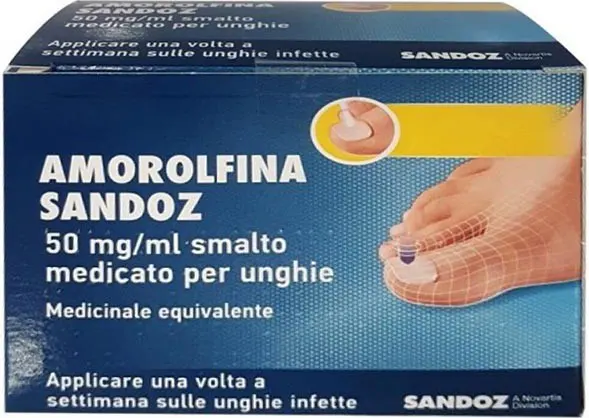
Nail polish for the treatment of onychomycosis caused by dermatophytes, yeasts, or molds.
Indications
Amorolfina Sandoz is a medicine for external use against nail infections caused by fungi (mycosis).
Amorolfina Sandoz is a nail polish that is used without a prescription for the treatment of nail fungus localized at the front and lateral edges of the nails, in cases where there are no more than two affected nails.
If, however, the infection affects a larger area than just the front and lateral edges, it is necessary to consult a doctor.
Nail fungus is commonly characterized by a white, yellow, or brown color and thickening of the nail, while the appearance of the actual infestation can vary. vary.
Composition
Active ingredients
Each 2.5 ml bottle contains 139.3 mg of amorolfine hydrochloride equivalent to 125 mg of amorolfine.
Excipients
Anhydrous ethanol, Ammonium methacrylate copolymer (type A), Ethyl acetate, Butyl acetate, Triacetin.
Directions for use and Dosage
The nail polish should be applied to the affected fingernails or toenails once a week.
Method of administration: For topical use. To be applied to the affected nails.
- Before each application, file the affected nail area (especially the nail surface) as thoroughly as possible. as thoroughly as possible with the nail file provided in the package.
The nail surface must be cleaned and degreased using one of the pads soaked in nail polish remover (provided in the package).
Before repeating the next application of Amorolfina Sandoz medicated nail polish, this filing and cleaning process must be repeated to remove any existing residual nail polish.
Caution: The nail files used for treatment must not be used on healthy nails. - Using the spatula provided, apply the polish to the entire surface of the affected nail and allow to dry.
For each nail to be treated, dip the spatula into the polish.
Caution: The spatula should not be rubbed on the edge of the bottle.
After use, clean the spatula with the swab soaked in nail polish remover.
After applying Amorolfina Sandoz medicated nail polish, an interval of at least 10 minutes must be respected before applying cosmetic nail polish.
It is important to wash your hands after applying Amorolfina Sandoz medicated nail polish.
If Amorolfine Sandoz medicated nail lacquer is applied to the fingers, patients should wait until the fingers are dry before washing their hands.
Duration of treatment: Treatment should be continued without interruption until the nail has regenerated and the affected area is completely healed.
In general, 6 months of treatment are required for fingernails and 9 to 12 months for toenails (the duration of treatment depends essentially on the intensity, location and extent of the infection).
After 3 months of treatment without results, consult your doctor.
Paediatric population: Due to the lack of clinical experience, children and adolescents should not be treated with Amorolfine Sandoz medicated nail lacquer.
Elderly: There are no specific dosage recommendations for use in elderly patients.
Warnings
During the application of Amorolfine Sandoz, artificial nails should not be used.
If organic solvents are used, waterproof gloves should be worn so as not to remove the layer of Amorolfine Sandoz on the nails, otherwise it will be removed.
After the application of Amorolfine Sandoz medicated nail lacquer, an interval of at least 10 minutes should be observed before applying a cosmetic nail lacquer (if desired).
However, with repeated use of Amorolfine Sandoz medicated nail lacquer, any nail lacquer applied should be removed before applying a new layer of Amorolfine Sandoz medicated nail lacquer.
Due to the lack of clinical experience, children and adolescents should not be treated with Amorolfine Sandoz medicated nail lacquer.
Avoid any contact of the nail lacquer with eyes, ears, and mucous membranes. Treatment should be determined by the doctor in the case of patients suffering from peripheral vascular disease, diabetes, immune system diseases, as well as in patients with nail dystrophy or severely damaged nails (with lesions exceeding two-thirds of the nail plate).
In these cases, systemic therapy should be considered. Patients with a history of lesions, skin conditions such as psoriasis or other chronic skin conditions, edema, respiratory problems (yellow nail syndrome), painful nails, distorted/deformed nails or other symptoms should consult their doctor before starting treatment.
Contraindications
Hypersensitivity to the active substance or to any of the excipients listed.
Interactions
No interaction studies have been performed.
Undesirable effects
Tabulated list of adverse reactions:
| System organ class | Incidence | Adverse reactions |
| Immune system disorders | Uncommon (≥1/1,000 to <1/100) | Hypersensitivity (allergic reaction) |
| Skin and subcutaneous tissue disorders | Rare (≥1/10,000 to <1/1,000) | Nail disorders, onychoclasis (broken nails), nail discoloration, onychorrhexis (brittle nails) and weak nails |
| Very rare (<1/10,000) | Skin burning sensation |
| Not known (cannot be estimated from the available data) | Erythema, pruritus, contact dermatitis, urticaria, blisters |
Reporting of suspected adverse reactions.
Reporting suspected adverse reactions after authorisation of the medicinal product is important. It allows continued monitoring of the benefit/risk balance of the medicinal product.
Overdose
No symptoms of overdose are expected following topical application of amorolfine 5% nail lacquer.
In case of accidental oral ingestion, if necessary, all appropriate measures should be taken to treatment of symptoms.
Pregnancy and lactation
Pregnancy: Reproductive toxicology studies have shown no evidence of teratogenicity in laboratory animals, but embryotoxicity has been observed at high oral doses of amorolfine.
Clinical experience with the use of amorolfine during pregnancy and lactation is limited.
Systemic absorption of amorolfine during and after topical administration is very low, therefore the fetal risk in humans would appear to be negligible.
However, as there is no significant experience, amorolfine should be avoided during pregnancy.
Lactation: It is not known whether amorolfine is excreted in human milk.
As there is no significant experience, amorolfine should be avoided during lactation.
Fertility: No data available.
Storage
Keep the bottle tightly closed.
Keep the medicated nail polish away from fire or flames (the alcohol base is flammable).
Format
2.5 ml bottle
Product Code:FRCM135689





 Richiedi info sul prodotto