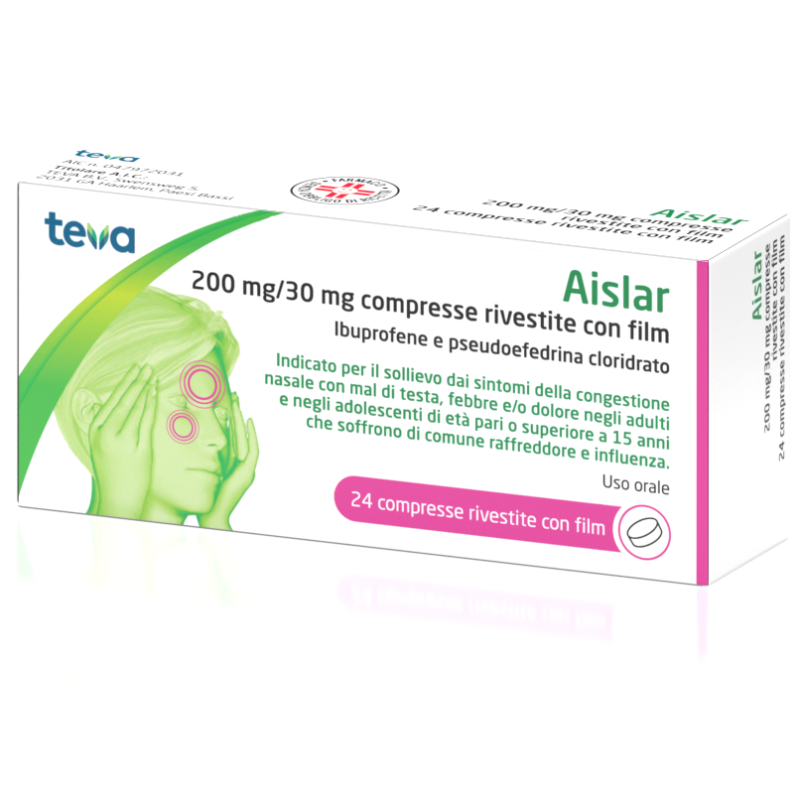
Aislar is a medicine containing ibuprofen and pseudoephedrine hydrochloride, indicated for the relief of symptoms of nasal congestion with headache, fever, and/or pain associated with colds and flu.
Indications
Aislar contains the active ingredients ibuprofen, a nonsteroidal anti-inflammatory drug (NSAID), and pseudoephedrine, a nasal decongestant.
- Ibuprofen relieves pain, swelling, and high temperature.
- Pseudoephedrine acts on the blood vessels inside the nose to relieve nasal congestion.
Aislar is Aislar is indicated for the relief of symptoms of nasal congestion with headache, fever, and/or pain associated with colds and flu.
Aislar is indicated in adults and adolescents over 15 years of age.
Use this combination product only if you have a stuffy nose with pain or fever. Do not use this product if you experience only one of these symptoms.
Contact your doctor if you do not notice any improvement or if you notice worsening of symptoms after 3 (for adolescents) or 5 (for adults) days.
Composition
Active ingredients
Ibuprofen and
pseudoephedrine hydrochlorideContraindications
Do not take Aislar:- if you are pregnant or breastfeeding. allergic to ibuprofen, pseudoephedrine or any of the other ingredients of this medicine (listed in section 6);
- if you are under 15 years of age;
- if you are if you are pregnant or breastfeeding;
- if you have previously developed an allergic reaction (such as wheezing, worsening of asthma, runny and itchy nose, swelling of the face or hives) while taking acetylsalicylic acid or other painkillers, antipyretics or anti-inflammatory drugs;
- if you have or have previously had stomach ulcers;
- if you have previously experienced perforation or bleeding related to taking NSAIDs;
- if you suffer from severe liver failure;
- if you suffer from severe acute (sudden) or chronic (long-term) kidney disease or kidney failure;
- if you suffer from severe heart failure;
- if you suffer from severe heart or circulation problems (heart disease, high blood pressure, angina, fast heart rate), hyperactivity or thyroid, diabetes, or pheochromocytoma (a tumor of the adrenal gland);
- if you have had a heart attack (myocardial infarction) in the past;
- if you have very high blood pressure (severe hypertension) or high blood pressure that is not controlled by medication;
- if you have had a stroke or are at risk of having a stroke;
- if you have had seizures in the past;
- if you have blood disorders of unknown origin;
- if you have glaucoma (increased pressure in the eye);
- if you have difficulty urinating due to prostate problems;
- if you have systemic lupus erythematosus (SLE), a disease that affects the immune system and causes, for example, joint pain and skin changes;
- if you are taking:
- acetylsalicylic acid (more than 75 mg per day) or other nonsteroidal anti-inflammatory drugs (NSAIDs) or pain relievers;
- other nasal decongestants such as phenylpropanolamine, phenylephrine, ephedrine or methylphenidate;
- non-selective monoamine oxidase inhibitors (known as MAOIs) (used in the treatment of Parkinson's disease or depression) or have taken MAOIs in the last 2 weeks.
Side effects
Like all medicines, this medicine can cause side effects. cause side effects, although not everybody gets them.
Stop taking Aislar immediately and see a doctor urgently:
- if you experience any of the following effects, which may be signs of a serious allergic reaction:
- difficulty breathing; breathing or swallowing;
- swelling of the face, lips, tongue, or throat;
- severe itching of the skin with hives;
- severe skin reactions with blisters under the skin;
- fast heartbeat with low blood pressure;
- if you experience signs of bleeding in the intestines such as:
- bright red stools (faeces), black tarry stools, vomiting blood or dark particles that look like coffee grounds;
- if you develop symptoms that could be signs of posterior reversible encephalopathy syndrome (Pres) and reversible cerebral vasoconstriction syndrome (RCVS). These include:
- severe headache with sudden onset;
- nausea;
- vomiting;
- confusion;
- seizures;
- changes in vision.
Other side effects may include:
Uncommon (may affect up to 1 in 100 people):
- headache, dizziness, difficulty sleeping, agitation, irritability; or tiredness;
- heart attack, convulsions, aseptic meningitis;
- visual disturbances;
- dry mouth, thirst;
- abdominal discomfort, dyspepsia, nausea, vomiting, diarrhoea, decreased appetite.
Rare (may affect up to 1 in 1,000 people):
- tinnitus (ringing in the ears);
- nervousness, tremor, anxiety, restlessness, hallucinations, insomnia;
- worsening of asthma;
- stomach pain, flatulence, constipation;
- swelling, high blood pressure, palpitations, fast heartbeat, heart attack, shortness of breath;
- heart rhythm disturbance, chest pain;
- damage to kidney tissue, concentration high uric acid levels in the blood;
- skin rashes, hives, itching, redness, excessive sweating.
Very rare (may affect up to 1 in 10,000 people):
- infectious inflammation, symptoms of meningitis (headache, fever, stiff neck);
- blood disorders (anaemia, leukopenia, thrombocytopenia, pancytopenia, agranulocytosis). The first signs are fever, sore throat, superficial mouth ulcers, flu-like symptoms, severe tiredness, nosebleeds and bruising of unknown origin;
- severe allergic reactions;
- psychotic reactions, depression;
- kidney failure or other kidney disease;
- liver disease;
- stomach ulcer, sometimes with bleeding or perforation (presence of blood in vomit or stool), gastritis, mouth ulcers, worsening of colitis and Crohn's disease, intestinal stenosis (narrowing);
- esophagitis (heartburn); pancreatitis;
- serious skin reactions including exfoliative dermatitis, Stevens-Johnson syndrome, erythema multiforme and toxic epidermal necrolysis;
- alopecia;
- serious skin infections, soft tissue complications of chickenpox infection.
Frequency not known (frequency cannot be estimated from the available data):
- serious conditions affecting the blood vessels in the brain known as posterior reversible encephalopathy syndrome (Pres) and reversible cerebral vasoconstriction syndrome (Rcvs);
- Drug reaction with eosinophilia and systemic symptoms: a serious skin reaction known as Dress syndrome may occur. Symptoms of Dress include rash, fever, swollen lymph nodes, and increased levels of eosinophils (a type of white blood cell);
- Widespread red, scaly rash, accompanied by fever, at the start of treatment, with wheals under the skin and blisters mainly localized in skin folds, on the trunk and upper limbs (acute generalized exanthematous pustulosis, Agep). Stop treatment with Aislar if you develop these symptoms and consult a doctor immediately. See also section 2; inflammation of the colon due to insufficient blood supply (ischemic colitis);
- the skin becomes sensitive to light;
- hallucinations, abnormal behavior;
- difficulty urinating in men with prostatic hypertrophy;
- reduction of blood supply to the optic nerve (ischemic optic neuropathy);
- chest pain, which may be a sign of a potentially serious allergic reaction called Kounis syndrome.
Reporting of side effects
If you get any side effects, talk to your doctor or pharmacist. This includes any possible side effects not listed in this leaflet. You can also tell your doctor or pharmacist if you experience any side effects. You can also report side effects directly via the national reporting system at: https://www.aifa.gov.it/content/segnalazionireazioni-avverse.
By reporting side effects, you can help provide more information on the safety of this medicine.
Pregnancy and breastfeeding
- if you are pregnant or breastfeeding;
Format
24 coated tablets
Product Code:FRCM234584





 Richiedi info sul prodotto