




- -16.45%

Recommended price

€33.34
 Richiedi info sul prodotto

Information on returns and shipments

Payment methods

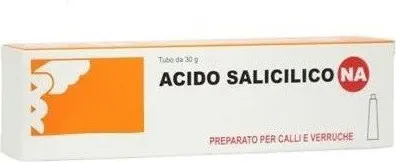
Topical medicine based on 10% salicylic acid.
Treatment of psoriasis, acne vulgaris, and seborrhea in adults and children; removal of warts and calluses in adults and children; local treatment of some forms of eczema and ichthyosis in adults.
Active ingredients
Salicylic acid 10% ointment. 100 g of ointment contain: Active ingredient: salicylic acid 10 g.
Excipients
White petrolatum.
Apply the smallest amount of ointment locally in relation to the area to be treated with a light massage. Start treatment by applying the medicine only to a small portion of skin or only once a day, so as not to irritate the skin.
Hypersensitivity to the active ingredient, to salicylates or to any of the excipients (patients hypersensitive to salicylates, such as acetylsalicylic acid, propyl salicylate, bromosalicylic acid, zinc salicylate, may also be hypersensitive to salicylic acid); children under 2 years of age; diabetes; peripheral vascular disease.
The following are the undesirable effects of salicylic acid, organized according to the MedDRA systemic classification. There are insufficient data to establish the frequency of the individual effects listed. Metabolism and nutrition disorders: Hypoglycaemia. Skin and subcutaneous tissue disorders: Irritation, dermatitis, burning, itching, erythema, skin desquamation, facial scarring. Reporting of suspected adverse reactions. Reporting suspected adverse reactions that occur after authorization of the medicinal product is important, as it allows continued monitoring of the benefit/risk balance of the medicinal product.
The medicinal product should not be swallowed. Salicylic acid is an irritant and may cause dermatitis. When treating corns and warts, the surrounding intact skin should be protected to minimize absorption of the active substance. Salicylic acid should not be used for long periods of time, at high concentrations, on large areas of the body, or on broken or inflamed skin, as excessive absorption of the active ingredient can cause systemic salicylate poisoning, especially in children, which can be fatal. Avoid contact with the mouth, eyes, genitals, and other mucous membranes. Use with caution in children as experience with the use of salicylic acid in this population is limited. Improvement of the treated skin may be observed after 6 weeks of therapy, or after 12 weeks if a wart is removed. The medicine may be flammable. Do not use or store near open flames or any heat source. Important information about some excipients: Not applicable.
There are no adequate data regarding the use of salicylic acid in pregnant and breastfeeding women. Therefore, salicylic acid solutions and ointments should not be used during pregnancy and breastfeeding unless absolutely necessary. Studies conducted on animals have shown reproductive toxicity. However, the potential risk for humans is unknown. However, it should be considered that despite being used topically, salicylic acid is absorbed systemically, easily crosses the placenta, being found in higher concentrations in fetal plasma, and is excreted in breast milk.
Do not store above 25°C. Keep the medicine in the tightly closed container protected from light, heat sources, or open flames.
Salicylic acid may cause allergic reactions. Interact with the following medicines: - Coumarin anticoagulants (acenocoumarol, dicoumarol, phenprocoumon, and warfarin) and 1,3-hydanedione derivatives (anisindione, phenidione), as salicylic acid can inhibit platelet aggregation and displace them from their binding site on plasma proteins, thus causing an increased risk of bleeding. - Inhibitors of activated coagulation factor X (heparins and heparinoids), as in case of neuraxial anesthesia (spinal or epidural), the concomitant use of salicylic acid can cause a rapid increase in the risk of bleeding and hematoma. - Glyburide, as excessive hypoglycemia may occur by an unknown mechanism. - Probenecid, as salicylic acid may cause the reversal of the uricosuric effects of this drug. - Acetazolamide, as this may increase the side effects of salicylate. - Varicella vaccine, as salicylic acid may increase the risk of developing Reye's syndrome. - Furthermore, salicylic acid should not be used simultaneously with tamarind (a tropical tree belonging to the Fabaceae family) and Salvia miltiorrhiza or Tan-Shen (a plant of the Labiatae family), as this may result in a rapid increase in plasma salicylate levels, resulting in increased toxicity.
No cases of overdose with locally applied salicylic acid have been reported. However, if the active ingredient is excessively absorbed (e.g., prolonged application over large areas of the body or on damaged and inflamed skin), salicylism may occur. Symptoms of salicylism include nausea, vomiting, tinnitus, and dizziness. Rarely, gastric ulcers, asthma, hepatotoxicity, renal failure, and pancreatic toxicity may occur.
30 g tube
This product has been on sale since 25/09/2017
In the last 30 days, the product's lowest price was 2,13 €

Estimated delivery: 1-3 business days

Estimated delivery: 1-3 business days

Estimated delivery: 1-3 business days

Estimated delivery: 1-3 business days

Estimated delivery: 1-3 business days

Estimated delivery: 1-3 business days

Estimated delivery: 1-3 business days