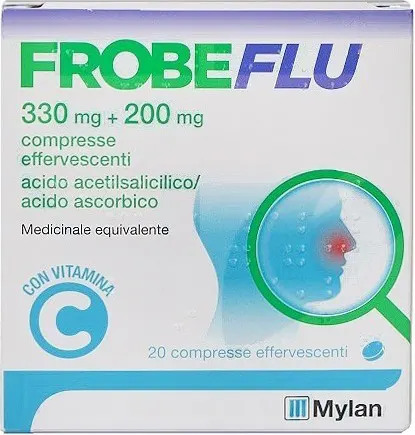
Frobeflu Acetylsalicylic Acid and Vitamin C 330 mg + 200 mg
Generic medicinal product
Composition:
Each effervescent tablet contains: Active ingredients: acetylsalicylic acid 330 mg; ascorbic acid 200 mg. For the full list of excipients, see section 6.1.
Excipients
Sodium bicarbonate, anhydrous citric acid, glycine, sodium benzoate.
Therapeutic indications
Symptomatic treatment of feverish and painful conditions (flu, colds, headache, toothache, rheumatic and muscular pain, menstrual pain, neuralgia).
Contraindications
Hypersensitivity to the active substances or to any of the excipients. Hypersensitivity to salicylates or other nonsteroidal anti-inflammatory drugs. Active gastro-duodenal ulcer and other gastropathies. Haemorrhagic diatheses (in particular haemophilia, hypoprothrombinemia and vitamin K deficiency). Severe hepatic or renal insufficiency. Patients with bronchial asthma, particularly if associated with nasal polyposis and angioedema. The use of this medicine is contraindicated in children and adolescents under 16 years of age. Doses >100 mg/day during the third trimester of pregnancy (see section 4.6). Children and adolescents with symptoms of influenza or chickenpox due to the risk of Reye's syndrome. Glucose-6-phosphate dehydrogenase deficiency.
Dosage
Adults, elderly people and children over 16 years of age The recommended doses are as follows: - As an antipyretic and analgesic for mild to moderate pain: - 1 tablet every 4-6 hours, as needed. - Rheumatic and muscle pain, neuralgia: 1-2 tablets, two-three times a day. It is recommended to dissolve the tablets in a glass of water. Do not exceed the recommended dose without medical advice; elderly patients in particular should stick to the minimum dosages indicated above. The product should be taken on a full stomach, particularly when high doses and prolonged periods are required.
Warnings and precautions
This medicine should not be used in children and adolescents under 16 years of age (see section 4.3). Individuals over 70 years of age, especially those on concomitant medications, should use this medicine only after consulting their doctor. After three days of use at the maximum dose or after 5–7 days of use without appreciable results, consult your doctor. Any use of high doses and/or for a long time should, however, only be done after consulting your doctor and under his direct supervision. Caution is also necessary in the following cases: – Elderly subjects with reduced renal function or reduced plasma albumin levels, due to the risk of greater toxicity; - Subjects affected by G6PD (Glucose 6-phosphate dehydrogenase) deficiency, due to the possible onset of haemolysis; - Subjects undergoing concomitant treatment with anticoagulants, due to an increased risk of haemorrhage (see section 4.5); - Subjects undergoing concomitant treatment with corticosteroids, due to an increased risk of gastrointestinal haemorrhage (see section 4.5). Ascorbic acid (vitamin C) should be used with caution by subjects who suffer, or have suffered in the past, from nephrolithiasis (kidney stones) and by those affected by G6PD (Glucose 6-phosphate dehydrogenase) deficiency, haemochromatosis, thalassaemia or sideroblastic anaemia. The activity of substances such as spironolactone, furosemide, and antigout preparations is reduced by acetylsalicylic acid. Therefore, avoid concomitant use of the latter with the above-mentioned drugs unless otherwise advised by your doctor (see section 4.5). Medicines containing acetylsalicylic acid are contraindicated (see section 4.3) in children and adolescents with viral infections, especially influenza A, influenza B, and chickenpox, due to the risk of Reye's syndrome, a very rare but life-threatening disease that requires immediate medical attention. Preoperative use is contraindicated as it may impair intraoperative haemostasis. If prolonged vomiting or profound drowsiness occurs during treatment, discontinue administration. If following a low-sodium diet, it should be noted that one effervescent tablet contains 485 mg of sodium (equivalent to 21 mEq). KEEP OUT OF THE REACH AND SIGHT OF CHILDREN.
Interactions
The administration of acetylsalicylic acid, particularly in case of prolonged therapy, can enhance the activity of anticoagulant drugs (for example, coumarin derivatives and heparin), the side effects of methotrexate, the risk of gastrointestinal bleeding in case of concomitant treatment with corticosteroids, the effects and secondary manifestations of all NSAIDs, the effect of oral hypoglycemics (sulfonylureas). Acetylsalicylic acid, on the other hand, reduces the activity of substances such as spironolactone, furosemide, and antigout preparations. Ascorbic acid can interfere, at high doses, with the results of some diagnostic tests, in particular the detection of glucose in urine with non-specific means. It is therefore advisable to consult a doctor before use. It is advisable to stop taking vitamin C a few days before undergoing this test.
Side effects
– Gastric disturbances (heartburn, epigastralgia), constipation, nausea. In sporadic cases and in predisposed patients, hemorrhagic episodes and ulcers may occur. – Allergic reactions, such as skin rashes, laryngeal edema, bronchospasm. In sensitive patients, an acute asthma attack may occur. The clinical picture, in patients sensitive to acetylsalicylic acid, may include asthma, nasal polyps, rhinorrhea, angioedema. – Tinnitus and decreased hearing may occur at high doses. Treatment should be temporarily suspended or the dosage reduced. – In patients with reduced renal function, acetylsalicylic acid may decrease renal blood flow and induce acute renal failure. - In extremely rare cases, thrombocytopenia may occur. - Reye's syndrome At doses higher than recommended, ascorbic acid may cause headache and gastrointestinal disorders, mainly consisting of laxative-type phenomena. In such cases, treatment should be discontinued. Pregnancy, puerperium, and perinatal conditions: Delayed delivery.
Pregnancy and breastfeeding
Since acetylsalicylic acid can cause haemorrhagic phenomena in the fetus and mother, delayed delivery, and, in the newborn, premature closure of the ductus arteriosus, its use is contraindicated in the third trimester of pregnancy (see section 4.3). Pregnancy: Low doses (up to 100 mg/day) Clinical studies indicate that doses up to 100 mg/day can be considered safe for obstetric use only, which requires specialist monitoring. Doses of 100–500 mg/day There are insufficient clinical data regarding the use of doses above 100 mg/day up to 500 mg/day. Therefore, the recommendations below for doses of 500 mg/day also apply to this dosage range. Doses of 500 mg/day and above Inhibition of prostaglandin synthesis may adversely affect pregnancy and/or embryo/fetal development. Results of epidemiological studies suggest an increased risk of miscarriage and of cardiac malformation and gastroschisis after use of a prostaglandin synthesis inhibitor in early pregnancy. The absolute risk of cardiac malformations was increased from less than 1% to approximately 1.5%. The risk was estimated to increase with dose and duration of therapy. In animals, administration of prostaglandin synthesis inhibitors has been shown to result in increased pre- and post-implantation loss and embryo-fetal mortality. Furthermore, an increased incidence of various malformations, including cardiovascular, has been reported in animals administered prostaglandin synthesis inhibitors during the organogenetic period. During the first and second trimesters of pregnancy, acetylsalicylic acid should not be administered unless clearly necessary. If acetylsalicylic acid is used by a woman attempting to conceive, or during the first and second trimesters of pregnancy, the dose and duration of treatment should be kept as low as possible. During the third trimester of pregnancy, all prostaglandin synthesis inhibitors may expose the fetus to: – cardiopulmonary toxicity (with premature closure of the ductus arteriosus and pulmonary hypertension); – renal dysfunction, which may progress to renal failure with oligo-hydroamnios; – the mother and newborn, at the end of pregnancy, to: – possible prolongation of bleeding time, and an antiplatelet effect that may occur even at very low doses; – inhibition of uterine contractions resulting in delayed or prolonged labor. Consequently, acetylsalicylic acid at doses >100 mg/day is contraindicated during the third trimester of pregnancy. During breastfeeding, the amount ingested by the infant after a single dose is negligible, while maternal ingestion of high doses should be avoided.
Product Code:FRCM046743




 Richiedi info sul prodotto