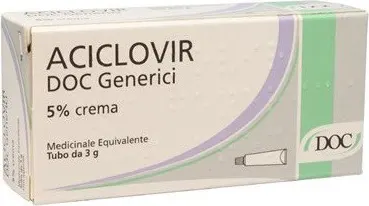
Aciclovir DOC 5% Cream
Composition:
100 g of cream contain: aciclovir 5 g (equivalent to 50 mg in 1 g).
Excipients
Propylene glycol; tefose; labrafil; vaseline oil; polaxamer 407; sodium lauryl sulfate; purified water.
Therapeutic indications
Aciclovir cream is indicated for the treatment of Herpes simplex skin infections such as: primary or recurrent genital herpes and herpes labialis.
Contraindications
Aciclovir cream is contraindicated in patients with known hypersensitivity to aciclovir, valaciclovir, propylene glycol or any of the excipients. Generally contraindicated in pregnancy and breastfeeding (see section 4.6).
Dosage
Aciclovir cream should be applied 5 times a day at approximately 4-hour intervals. Aciclovir cream should be applied to the lesions or areas where they are developing as early as possible after the onset of the infection. It is particularly important to start treatment of recurrent episodes during the prodrome phase or at the first appearance of the lesions. Treatment should continue for at least 5 days and up to a maximum of 10 if healing has not occurred.
Warnings and precautions
The product is not for ophthalmic use. Application of aciclovir cream to mucous membranes such as those of the mouth, eyes, or vagina is not recommended. Particular care should be taken to avoid accidental application to the eyes. Animal studies indicate that vaginal application of aciclovir cream can cause reversible irritation. Use of the product, especially if prolonged, may give rise to sensitization phenomena. If this occurs, discontinue treatment and consult your doctor. In severely immunocompromised patients (AIDS patients or bone marrow transplant patients), the administration of aciclovir in oral formulations should be considered. These patients should be advised to consult their doctor regarding the treatment of any infection. The excipient propylene glycol may cause allergic reactions. cause skin irritation.
Interactions
No clinically significant interactions have been identified.
Undesirable effects
The following convention has been used for the classification of undesirable effects in terms of frequency: very common > 1/10, common > 1/100 and < 1/10, uncommon > 1/1,000 and < 1/100, rare > 1/10,000 and < 1/1,000, very rare < 1/10,000. Data from clinical trials have been used to assign frequency categories to the adverse reactions observed during clinical trials with aciclovir 3% ophthalmic ointment. Due to the nature of the adverse events observed, it is not possible to determine unequivocally which events are related to the administration of the drug and which are related to the disease itself. Data from spontaneous reports were used as a basis for determining the frequency of those events identified by post-marketing surveillance. Skin and subcutaneous tissue disorders Uncommon: Transient burning or stinging, moderate dryness, skin peeling, and itching. Rare: Erythema, contact dermatitis after application. Where sensitivity testing was conducted, reactivity was shown to be related to the cream components rather than to aciclovir. Immune system disorders Very rare: Immediate hypersensitivity reactions including angioedema and urticaria.
Pregnancy and lactation
Fertility Reversible toxic effects on spermatogenesis have been reported in rats and dogs only at systemic doses considerably higher than therapeutic doses. Two-generation studies in mice have shown no effect of orally administered aciclovir on fertility. No data are available on the effects of aciclovir cream on female fertility. Aciclovir tablets have not been shown to affect sperm count, morphology, or motility in humans. Pregnancy: The use of aciclovir should be considered only when the potential benefits outweigh any possible unknown risks, although systemic exposure to aciclovir following topical application of aciclovir cream is very low. A registry on the use of aciclovir during pregnancy has provided data on pregnancy outcomes in women exposed to various aciclovir formulations after marketing. The registry results did not show an increase in the number of birth defects among subjects exposed to aciclovir compared to the general population, and all birth defects did not show any unique or common features that would suggest a single cause. In conventional, internationally accepted tests, systemic administration of aciclovir did not produce embryotoxic or teratogenic effects in rabbits, rats, or mice. In an experimental study in rats, not included in classical teratogenicity tests, fetal abnormalities were observed after subcutaneous doses of acyclovir high enough to produce toxic effects in the mother. The clinical relevance of these findings is uncertain. Breastfeeding: Limited data in humans indicate that the drug is found in breast milk after systemic administration. However, the dose received by a nursing infant following maternal use of acyclovir cream is expected to be insignificant.
Product Code:FRCM046248




 Richiedi info sul prodotto