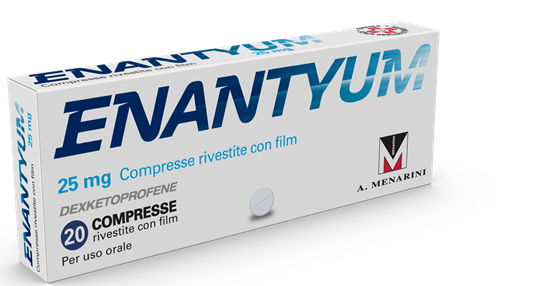
ENANTYUM 25 mg is a painkiller belonging to the group of nonsteroidal anti-inflammatory drugs (NSAIDs), used to treat mild to moderate pain, such as muscle pain, painful periods, and toothache.
Indications
Enantyum is a painkiller belonging to the group of medicines called nonsteroidal anti-inflammatory drugs (NSAIDs).
It is used to treat mild to moderate pain, such as muscle pain, painful periods, and toothache. Mild to moderate side effects, such as muscle pain, painful periods (dysmenorrhea), toothache. Talk to your doctor if you do not feel better or if you feel worse after 3 to 4 days.
Composition
Active ingredients
- 36.9 mg DEXKETOPROFEN TROMETAMOL SALT
Interactions
Tell your doctor or pharmacist if you are taking, have recently taken, or might take any other medicines, including medicines obtained without a prescription. Some medicines cannot be used in combination, while others require dosage adjustments if taken at the same time.
Always tell your doctor, dentist or pharmacist if you are using or are being given any of the following medicines in addition to Enantyum:
Combinations that are not advisable:
- Acetylsalicylic acid, corticosteroids or other anti-inflammatory drugs
- Warfarin, heparin or other medicines used to prevent the formation of blood clots
- Lithium, used to treat certain mood disorders
- Methotrexate (an anti-cancer medicine or immunosuppressant), used in doses greater than 15 mg/week
- Hydantoin and phenytoin, used for epilepsy
- Sulfamethoxazole, used for bacterial infections
Combinations requiring precaution:
- ACE inhibitors, diuretics and angiotensin II antagonists, used for high blood pressure and heart problems
- Pentoxifylline and oxpentifylline, used to treat chronic venous ulcers
- Zidovudine, used in the treatment of viral infections
- Antibiotics aminoglycosides, used in the treatment of bacterial infections
- Sulfonylureas (e.g. chlorpropamide and glibenclamide) used for diabetes
- Methotrexate, used at low doses, less than 15 mg/week
Combinations to be carefully evaluated:
- Quinolone antibiotics (e.g. ciprofloxacin, levofloxacin) used for bacterial infections
- Cyclosporine or tacrolimus, used to treat immune system disorders and in liver transplants organs
- Streptokinase and other thrombolytics or fibrinolytics drugs, i.e. medicines used to dissolve blood clots;
- Probenecid, used for gout;
- Digoxin, used in the treatment of chronic heart failure;
- Mifepristone, used as an abortifacient (to terminate a pregnancy);
- Antidepressants of the Selective Serotonin Reuptake Inhibitor (SSRI) type;
- Antiplatelet agents used to reduce platelet aggregation and blood clot formation;
Beta-blockers, used for high blood pressure and heart problems; Tefonovir, deferasirox, pemetrexedIf you have any further questions about taking other medicines in combination with Enantyum, ask your doctor or pharmacist.
Warnings
Talk to your doctor or pharmacist before using Enantyum:
- If you suffer from allergy, or have had problems due to allergies in the past;
- If you have kidney problems, liver problems or heart problems (hypertension and/or heart failure) or fluid retention, or have previously suffered from one of these conditions;
- If you have hypertension and/or heart failure; are taking diuretics or have problems with very poor hydration or have a reduced blood volume due to excessive fluid loss (for example, through excessive urination, diarrhoea, vomiting);
- If you have heart problems, if you have had a stroke or if you think you may be at risk of these conditions (for example, if you have high blood pressure, diabetes or high cholesterol or if you are a smoker) you should discuss your treatment with your doctor or pharmacist; medicines such as Enantyum may be associated with a small increased risk of heart attack (“myocardial infarction”) or stroke. These risks are more serious than those seen in adults. likely with high doses of the drug and with prolonged therapy. Do not exceed the recommended dose or duration of treatment;
- If you are elderly: there is a greater probability of being subject to side effects; If these occur, consult your doctor immediately;
- If you are elderly: there is a greater probability of being subject to side effects; a woman with fertility problems (Enantyum may reduce your fertility, so you should not take the medicine if you are planning to become pregnant or are undergoing fertility tests);
- If you suffer from a disorder of blood and blood cell formation;
- If you suffer from systemic lupus erythematosus or mixed connective tissue disease (immune system disorders affecting the connective tissue);
- If you have suffered in the past from a chronic inflammatory bowel disease (ulcerative colitis, Crohn's disease);
- If you have or have suffered in the past from other stomach or intestinal disorders in the intestine;
- If you have chickenpox, as exceptionally NSAIDs may worsen the infection;
- If you are taking other medicines that increase the risk of peptic ulcer or bleeding, for example oral steroids, some antidepressants (those of the SSRI type, i.e. Selective Serotonin Reuptake Inhibitors), medicines that prevent blood clots such as aspirin or anticoagulants such as warfarin. In these cases, consult your doctor before taking Enantyum: this may cause serious side effects. prescribe an additional medicine to protect your stomach (for example misoprostol or other medicines that block the production of stomach acids);
- If you suffer from asthma associated with chronic rhinitis, chronic sinusitis, and/or nasal polyposis as you have a higher risk of allergy to acetylsalicylic acid and/or NSAIDs than the rest of the population. Administration of this medicine may cause asthma attacks or bronchospasm, particularly in subjects allergic to acetylsalicylic acid or NSAIDs.
Children and adolescents
Enantyum is not indicated for children under 18 years of age. It has been studied in children and adolescents. Therefore, safety and efficacy have not been established and the product should not be used in children and adolescents.
Contraindications
- If you are allergic to dexketoprofen or any of the other ingredients of this medicine;...
allergic to acetylsalicylic acid or other
non-steroidal anti-inflammatory drugs;If you have asthma or have suffered from asthma attacks, acute allergic rhinitis (a short period of inflammation of the nasal mucosa), nasal polyps (polypoid masses in the nose due to allergy), urticaria (skin rash), angioedema (swelling of the face, eyes, lips, or tongue, or difficulty breathing) or wheezing in the chest after taking acetylsalicylic acid or other
non-steroidal anti-inflammatory drugs;If you have suffered from photoallergic reactions or
phototoxicity (a particular form of redness and/or blistering of the skin following exposure to sunlight) during treatment with
ketoprofen (a non-steroidal anti-inflammatory drug) or
fibrates (medicines used to reduce fat levels in the blood);If you suffer from a
peptic ulcer/bleeding of the stomach or intestines or if you have suffered in the past from
bleeding of the stomach or intestines,
ulceration or
perforation;If you suffer from
chronic digestive problems (e.g.
indigestion,
heartburn);If you have suffered in the past from
bleeding or perforation of the stomach or intestines due to previous use of
non-steroidal anti-inflammatory drugs (NSAIDs) used for pain;If you suffer from
intestinal diseases with chronic inflammation (
Crohn's disease or
ulcerative colitis);If you suffer from
severe heart failure, or have
moderate to severe kidney problems or
serious liver problems;If you have
bleeding problems or
clotting disorders;If you are
severely dehydrated (have lost a large amount of body fluids) due to
vomiting,
diarrhoea or
insufficient fluid intake;If you have
acute kidney problems, or
angina ... in the third trimester of pregnancy or are breastfeeding.Side effects
Like all medicines, this medicine can cause side effects, although not everybody gets them.
Possible side effects are listed below, ranked by likelihood. with which they may occur.
Common side effects: may affect up to 1 in 10 patients
- Nausea and/or vomiting, abdominal pain mainly in the upper quadrants, diarrhoea, digestive problems (dyspepsia).
Uncommon side effects: may affect up to 1 in 100 patients
- Vertigo, dizziness, drowsiness, sleep disturbances, nervousness, headache, palpitations, hot flushes, inflammation of the stomach lining (gastritis), constipation, dry mouth, flatulence, rash, tiredness, pain, feeling feverish and chills, feeling generally unwell.
Rare side effects: may affect up to 1 in 1,000 people
- Peptic ulcer, haemorrhagic or perforated peptic ulcer (which may show traces of blood in vomit or stools), fainting, high blood pressure, slow breathing, fluid retention and oedema peripheral (e.g. swollen ankles), larynx edema, loss of appetite (anorexia), changes in sensation (paraesthesia), itchy rash, acne, increased sweating, low back pain, frequent urination, menstrual disorders, prostate problems, tests of liver function abnormal liver function (blood tests), liver cell damage (hepatitis), acute renal failure.
Very rare side effects: may affect up to 1 in 10,000 people
- Anaphylactic reaction (hypersensitivity reaction which may also lead to collapse), ulceration of the skin, mouth, eyes and genital area (Stevens-Johnson and Lyell syndromes), facial swelling or swelling of the lips and throat (angioedema), difficulty breathing. respiratory distress due to contraction of the muscles surrounding the airways (bronchospasm), shortness of breath, rapid heartbeat, low blood pressure, pancreatitis, blurred vision, ringing in the ears (tinnitus), skin reactions, hypersensitivity reactions. in the light, itching, kidney problems.
- Decrease in white blood cells (neutropenia), decrease in blood platelets (thrombocytopenia).
Tell your doctor immediately if you notice side effects in the stomach or intestines at the beginning of treatment (for example stomach pain, acidity or bleeding), if you have previously suffered from some of these side effects due to the long-term use of anti-inflammatory drugs, and especially if you are elderly.
Stop using Enantyum as soon as you notice the appearance of a skin rash, or any lesions on the inside of the mouth or genitals, or any sign of allergy.
During treatment with non-steroidal anti-inflammatory drugs, fluid retention and swelling (particularly in the ankles and legs), an increase in blood pressure and heart failure have been reported.
Medicines such as Enantyum may be associated with a small increased risk of heart attack (“myocardial infarction”) or cerebrovascular accidents (stroke).
In patients with immune system disorders affecting the connective tissue (systemic lupus erythematosus or mixed connective tissue disease), anti-inflammatory medicines may rarely cause fever, headache and neck stiffness.
The adverse events most commonly observed are gastrointestinal in nature. Peptic ulcers, perforation or gastrointestinal bleeding may occur, sometimes fatal, especially in the elderly. Nausea, vomiting, diarrhea, flatulence, constipation, dyspepsia, abdominal pain, melaena, haematemesis, ulcerative stomatitis, worsening of colitis and Crohn's disease have been reported following administration. Less frequently, inflammation of the stomach wall (gastritis) has been observed.
As with other NSAIDs, haematological reactions may occur (purpura, aplastic and haemolytic anaemia and rarely agranulocytosis and medullary hypoplasia).
Reporting of side effects
If you get any side effects, talk to your doctor or pharmacist. You can also report side effects directly via the national reporting system at: https://www.aifa.gov.it/content/segnalazionireazioni-avverse.
By reporting side effects you can: Help provide more information on the safety of this medicine.
Pregnancy and breastfeeding
If you are in the third trimester of pregnancy or are breastfeeding.
Format
10 film-coated tablets
Product Code:FRCM226149





 Richiedi info sul prodotto


