




Recommended price

€4.69
Get free shipping with a minimum spend of 69,00 €. Or by purchasing one of the selected products. Discover them now!
 Richiedi info sul prodotto

Information on returns and shipments

Payment methods

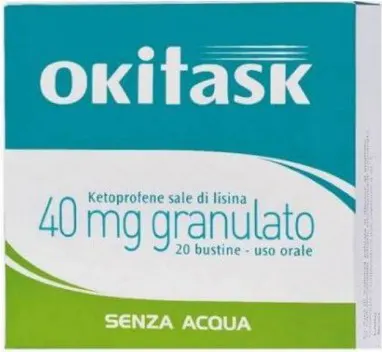
OKitask 40 mg Granules Sachets
Pains of various origins and natures, and in particular: headache, toothache, neuralgia, menstrual pain, muscle and osteoarticular pain.
Each sachet contains: Active ingredient: ketoprofen lysine salt 40 mg (corresponding to 25 mg of ketoprofen). For the full list of excipients, see section 6.1.
Povidone, colloidal silica, hydroxypropyl methylcellulose, eudragit EPO, sodium dodecyl sulfate, stearic acid, magnesium stearate, aspartame, mannitol, xylitol, talc, lime flavouring, lemon flavouring, frescofort flavouring
The medicine should not be administered in the following cases: • hypersensitivity to the active substance or to other similar drugs (anti-inflammatories, acetylsalicylic acid and its derivatives, etc.), hypersensitivity to any of the excipients; • manifestations with skin rashes, rhinitis or asthma;• confirmed or suspected pregnancy (see section 4.6 - Pregnancy and breastfeeding), during breastfeeding and in children under 15 years of age; • patients with gastric or duodenal ulcer, gastritis and chronic dyspepsia; • subjects with leukopenia or thrombocytopenia, with active bleeding or bleeding diathesis, under treatment with anticoagulants; • patients with severe renal or hepatic insufficiency; • patients undergoing major surgery. Furthermore, concomitant administration with other anti-inflammatory drugs and acetylsalicylic acid is not recommended. Active peptic ulcer, or previous history of gastrointestinal bleeding, ulceration or perforation related to previous active treatments or history of recurrent peptic ulcer/hemorrhage (two or more distinct episodes of proven ulceration or hemorrhage). Severe heart failure.
Adults and children over 15 years: 1 sachet, as a single dose, or repeated 2-3 times a day, for more intense forms of pain. The contents of the sachet can be placed directly on the tongue. It dissolves in saliva, allowing it to be used without water. It is best to take the product on a full stomach. Do not exceed the recommended dose: elderly patients in particular should stick to the minimum doses indicated above. The duration of therapy should be limited to overcoming the painful episode.
The product should be used only under medical supervision in patients with bronchospasm or suffering from chronic obstructive pulmonary disease, allergic rhinitis (hay fever), or nasal polyps, as well as in cases of nephropathy. After a few days of treatment without appreciable results, consult your doctor. The use of OKITASK 40 mg granules, as with any drug that inhibits the synthesis of prostaglandins and cyclooxygenase, is not recommended in women intending to become pregnant. Administration of OKITASK 40 mg granules should be suspended in women who have fertility problems or who are undergoing fertility investigations. Concomitant use of OKITASK 40 mg granules with other NSAIDs, including selective cyclooxygenase-2 inhibitors, should be avoided. Undesirable effects can be minimized by using the lowest effective dose for the shortest duration necessary to control symptoms (see sections below on gastrointestinal and cardiovascular risks). Administer with caution in patients with allergic reactions or a history of allergies. Patients with current or history of gastrointestinal disease should be carefully monitored for digestive disturbances, especially gastrointestinal bleeding. Caution is required when administering the product to patients with hepatic porphyria, as the drug may trigger an attack. Elderly: Elderly patients have an increased frequency of adverse reactions to NSAIDs, especially gastrointestinal bleeding and perforation, which may be fatal (see section 4.2 - Posology and method of administration). Gastrointestinal effects: Gastrointestinal bleeding, ulceration and perforation: Gastrointestinal bleeding, ulceration and perforation, which can be fatal, have been reported with all NSAIDs at anytime during treatment, with or without warning symptoms or a previous history of serious gastrointestinal events. Some epidemiological evidence suggests that ketoprofen may be associated with a higher risk of serious gastrointestinal toxicity than other NSAIDs, particularly at high doses (see also sections 4.2 - Posology and method of administration and 4.3 - Contraindications). Elderly patients are more susceptible to decreased renal, cardiovascular, or hepatic function. In the elderly and in patients with a history of ulcers, particularly if complicated with haemorrhage or perforation (see section 4.3 - Contraindications), the risk of gastrointestinal bleeding, ulceration, or perforation is higher with increasing doses of NSAIDs. These patients should start treatment on the lowest available dose. Concomitant use of protective agents (misoprostol or proton pump inhibitors) should be considered for these patients and also for patients taking low-dose aspirin or other drugs that may increase the risk of gastrointestinal events (see below and section 4.5 - Interactions with other medicinal products and other forms of interaction). Patients with a history of gastrointestinal toxicity, particularly the elderly, should report any abdominal symptoms (especially gastrointestinal bleeding), particularly in the initial stages of treatment. Caution should be advised in patients taking concomitant medications which could increase the risk of ulceration or bleeding, such as oral corticosteroids, anticoagulants such as warfarin, selective serotonin reuptake inhibitors, or antiplatelet agents such as aspirin (see section 4.5 - Interactions with other medicinal products and other forms of interaction). If gastrointestinal bleeding or ulceration occurs in patients taking OKITASK 40 mg granules, the treatment should be discontinued. NSAIDs should be administered with caution to patients with a history of gastrointestinal disease (ulcerative colitis, Crohn's disease), as these conditions may be exacerbated (see section 4.8 - Undesirable effects). Skin effects Serious skin reactions, some of them fatal, including exfoliative dermatitis, Stevens-Johnson syndrome, and toxic epidermal necrolysis, have been reported very rarely in association with the use of NSAIDs (see section 4.8 - Undesirable effects). Patients appear to be at higher risk in the early stages of therapy: the onset of the reaction occurs in most cases within the first month of treatment. OKITASK 40 mg granules should be discontinued at the first appearance of skin rash, mucosal lesions, or any other sign of hypersensitivity. Cardiovascular and cerebrovascular effects: Caution is advised (discuss with your doctor or pharmacist) before initiating treatment in patients with a history of hypertension and/or heart failure, as fluid retention, hypertension, and edema have been reported in association with NSAID treatment. Clinical studies and epidemiological data suggest that the use of some NSAIDs (particularly at high doses and for long-term treatment) may be associated with a modest increased risk of arterial thrombotic events (e.g., myocardial infarction or stroke). There are currently insufficient data to exclude a similar risk for ketoprofen when it is administered at the daily dose of one sachet, as a single dose, or repeated 2-3 times a day. OKITASK 40 mg granules contain aspartame as a sweetener: this substance is contraindicated in subjects with phenylketonuria. OKITASK 40 mg granules do not affect low-calorie or controlled diets and can also be administered to diabetic patients.
Since the protein binding of ketoprofen is high, it may be necessary to reduce the dosage of diphenylhydantoin or sulfonamides that may be administered simultaneously. During therapy with lithium-based drugs, the concomitant administration of nonsteroidal anti-inflammatory drugs causes an increase in plasma lithium levels. Potential interactions with the following drugs should be considered: oral hypoglycemics (sulfonamides), ticlopidine, anti-inflammatories, and methotrexate. Therefore, patients undergoing treatment with these drugs should consult their doctor before taking the product. Corticosteroids: increased risk of gastrointestinal ulceration or bleeding (see section 4.4 - Special warnings and precautions for use). Anticoagulants: NSAIDs may enhance the effects of anticoagulants, such as warfarin (see section 4.4 - Special warnings and precautions for use). Antiplatelet agents and selective serotonin reuptake inhibitors (SSRIs): increased risk of gastrointestinal bleeding (see section 4.4 - Special warnings and precautions for use). Diuretics, ACE inhibitors, and angiotensin II antagonists: NSAIDs may reduce the effect of diuretics and other antihypertensive drugs. In some patients with compromised renal function (e.g., dehydrated patients or elderly patients with compromised renal function), the co-administration of an ACE inhibitor or an angiotensin II antagonist and agents that inhibit the cyclo-oxygenase system may lead to further deterioration of renal function, including possible acute renal failure, which is usually reversible. These changes should be considered in patients taking OKITASK 40 mg granules concomitantly with ACE inhibitors or angiotensin II antagonists. Therefore, the combination should be administered with caution, especially in elderly patients. Patients should be adequately hydrated, and monitoring of renal function should be considered after initiating concomitant therapy.
Gastrointestinal tract: The most commonly observed adverse events are gastrointestinal in nature. Peptic ulcers, perforation, or gastrointestinal bleeding, sometimes fatal, may occur, particularly in the elderly (see section 4.4 - Special warnings and precautions for use). The frequency and severity of these effects are significantly reduced when the drug is taken with food. Nausea, vomiting, diarrhea, flatulence, constipation, dyspepsia, abdominal pain, melaena, hematemesis, ulcerative stomatitis, exacerbation of colitis and Crohn's disease have been reported following administration of ketoprofen (see section 4.4 - Special warnings and precautions for use). Gastritis has been observed less frequently. More rarely, disorders affecting the haematopoietic system and effects on the central nervous system have been reported: headache, dizziness, asthenia, and mood changes. Allergic reactions such as skin rash, pruritus, and edema are equally rare. In exceptional cases, manifestations of hypersensitivity may take the form of severe systemic reactions (laryngeal edema, glottis edema, dyspnea, palpitations) or even anaphylactic shock. In these cases, immediate medical attention is required. Edema, hypertension, and cardiac failure have been reported in association with NSAID treatment. Bullous reactions, including Stevens-Johnson syndrome and toxic epidermal necrolysis, have been reported very rarely. Immune system disorders: hypersensitivity, anaphylaxis. Psychiatric disorders: mood alterations. Nervous system disorders: headache, dizziness. Cardiac disorders: palpitations, cardiac failure. Vascular disorders: hypertension. Respiratory, thoracic, and mediastinal disorders: dyspnea, laryngeal edema, glottis edema. Gastrointestinal disorders: diarrhea, nausea, vomiting, constipation, flatulence, gastritis, abdominal pain, dyspepsia, ulcerative stomatitis, melaena, hematemesis, gastrointestinal bleeding, duodenal ulcer and perforation, gastric ulcer and perforation, aggravation of colitis and Crohn's disease. Skin and subcutaneous tissue disorders: pruritus, edema, exanthema, Stevens-Johnson syndrome, toxic epidermal necrolysis. Systemic disorders and administration site conditions: asthenia, edema. Clinical trial and epidemiological data suggest that use of some NSAIDs (particularly at high doses and in long-term treatment) may be associated with a small increased risk of arterial thrombotic events (for example, myocardial infarction or stroke) (see section 4.4 - Special warnings and precautions for use).
Pregnancy Inhibition of prostaglandin synthesis may adversely affect the pregnancy and/or the embryo/foetal development. Results of epidemiological studies suggest an increased risk of miscarriage and of cardiac malformation and gastroschisis after use of a prostaglandin synthesis inhibitor in early pregnancy. The absolute risk for cardiac malformations increased from less than 1%, up to approximately 1.5%. The risk is believed to increase with dose and duration of therapy. In animals, administration of prostaglandin synthesis inhibitors has been shown to result in increased pre- and post-implantation loss and embryo-fetal mortality. Additionally, an increased incidence of various malformations, including cardiovascular, has been reported in animals administered prostaglandin synthesis inhibitors during the organogenetic period. During the third trimester of pregnancy, all prostaglandin synthesis inhibitors may expose the fetus to: - cardiopulmonary toxicity (with premature closure of the ductus arteriosus and pulmonary hypertension); - renal dysfunction, which may progress to renal failure with oligo-hydroamniosis; the mother and newborn, at the end of pregnancy, to: - possible prolongation of bleeding time, and an antiplatelet effect that may occur even at very low doses; - inhibition of uterine contractions resulting in delayed or prolonged labor. Breastfeeding: Do not administer during breastfeeding.
This product has been on sale since 25/09/2017
In the last 30 days, the product's lowest price was 6,93 €
Va bene
Sempre ottimi prezzi
Le ho prese per i miei genitori io sono allergiche e sono ottime
Buono
Usata da me come unica opzione che fa scomparire un fastidio come il mal di testa


