




- -23.28%

Recommended price

€16.11
Get free shipping with a minimum spend of 69,00 €. Or by purchasing one of the selected products. Discover them now!
 Richiedi info sul prodotto

Information on returns and shipments

Payment methods


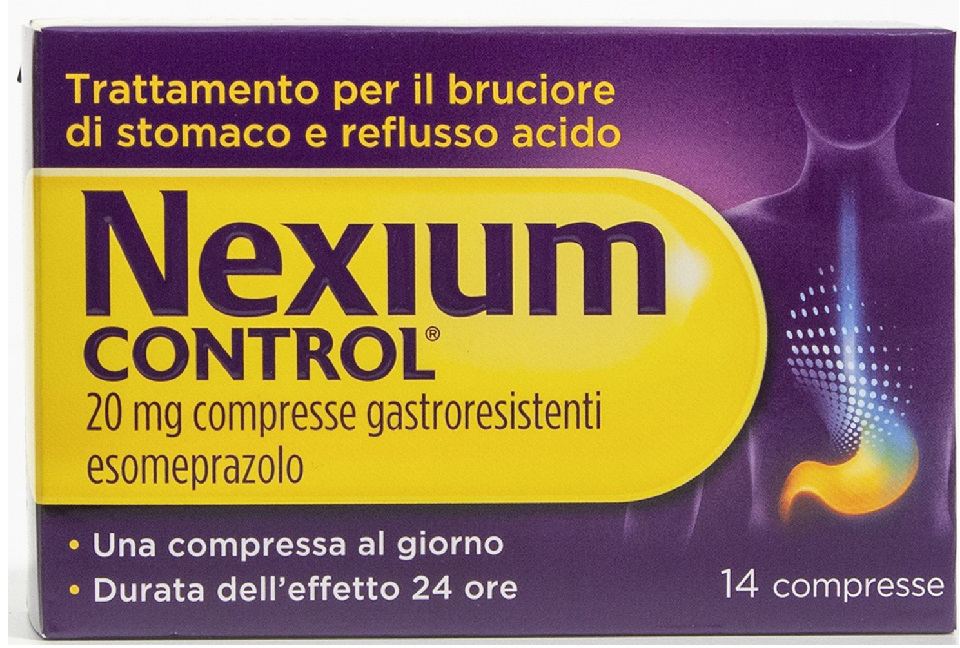
Treatment for heartburn and acid reflux.
Nexium Control is a non-prescription medicine indicated in adults for the short-term treatment of reflux symptoms (e.g. heartburn and acid regurgitation).
Esomeprazole (as magnesium trihydrate).
Glycerol monostearate 40-55, hyprolose, hypromellose, iron oxide (red-brown) (E 172), iron oxide (yellow) (E 172), magnesium stearate, methacrylic acid copolymerized ethyl acrylate (1:1) dispersion 30%, microcrystalline cellulose, synthetic paraffin, macrogol 6000, polysorbate 80, crospovidone (Type A), sodium stearyl fumarate, sugar spheres (sucrose), talc, titanium dioxide (E 171), triethyl citrate.
The recommended dose is 20 mg esomeprazole (one tablet) daily.
It may be necessary to take the tablets for 2-3 consecutive days to obtain improvement of symptoms.
The duration of treatment is up to 2 weeks.
Once complete resolution of symptoms has been achieved, treatment should be discontinued.
If resolution of symptoms is not achieved within 2 weeks of continuous treatment, the patient should consult a doctor.
Patients with renal impairment: No dose adjustment is necessary in patients with impaired renal function.
Given the limited experience in patients with severe renal insufficiency, such patients should be treated with caution.
Patients with hepatic impairment: No dose adjustment is necessary in patients with mild or moderate hepatic impairment.
However, patients with severe hepatic impairment should be advised by a doctor before taking the medicine.
Elderly patients (>=65 years): No dose adjustment is necessary in elderly patients.
Paediatric population: There is no relevant use of the medicinal product in the paediatric population under 18 years of age in the indication: "short-term treatment of reflux symptoms (e.g. heartburn and acid regurgitation)".
Method of administration: The tablets should be swallowed whole with half a glass of water.
The tablets should not be chewed or crushed.
Alternatively, the tablet can be swallowed whole with half a glass of water.
The tablets should not be chewed or crushed.
Alternatively, the tablet can be swallowed whole with half a glass of water. be dispersed in half a glass of still water.
Other liquids should not be used as the enteric-coated tablet may dissolve.
The water should be stirred until the tablet is dispersed.
The liquid with the granules should be drunk immediately or within 30 minutes.
The glass should be rinsed with half a glass of water and the water drunk.
The granules should not be chewed or crushed.
Patients should be instructed to consult a doctor if: they have significant unintentional weight loss, recurrent vomiting, dysphagia, haematemesis or melaena and when gastric ulcer is suspected or present, malignancy should be excluded as therapy with esomeprazole may alleviate symptoms and delay diagnosis.
They have had a previous gastric ulcer or gastrointestinal surgery.
Have been on continuous symptomatic treatment for indigestion or heartburn for 4 or more weeks.
Have jaundice or severe liver disease.
Are over 55 years of age with new or recently changed symptoms.
Patients with long-term recurrent symptoms of indigestion or heartburn should consult their doctor at regular intervals.
Patients should not take the product as a long-term preventive medication.
Treatment with proton pump inhibitors (PPIs) may increase the risk of heartburn. lead to a slightly increased risk of gastrointestinal infections such as Salmonella and Campylobacter, and possibly also Clostridium difficile in hospitalized patients.
Patients should consult their doctor before taking this medicine if they are to undergo endoscopy or urea breath test.
Co-administration of esomeprazole and atazanavir is not recommended.
If the combination of atazanavir with a proton pump inhibitor is judged unavoidable, close clinical monitoring is recommended in combination with an increase in the dose of atazanavir to 400 mg with 100 mg of ritonavir.
The dose of 20 mg esomeprazole should not be exceeded.
Esomeprazole is a CYP2C19 inhibitor.
When starting or ending treatment with esomeprazole, the potential for interactions with medicinal products metabolised by atazanavir should be considered. CYP2C19.
An interaction between clopidogrel and esomeprazole has been observed.
The clinical relevance of this interaction is uncertain.
The use of esomeprazole with clopidogrel should be discouraged.
Patients should not take another PPI or H2 antagonist concomitantly.
This medicinal product contains sugar spheres (sucrose).
An increased level of Chromogranin A (CgA) may interfere with investigations for neuroendocrine tumors.
To avoid this interference, esomeprazole treatment should be temporarily stopped for five days before CgA determination.
Hypersensitivity to esomeprazole, substituted benzimidazoles, or to any of the excipients; Esomeprazole should not be used concomitantly with nelfinavir.
Since esomeprazole is an enantiomer of omeprazole, it is advisable to consider the interactions observed with omeprazole.
Interactions between omeprazole and some protease inhibitors have been reported.
An increase in gastric pH during treatment with omeprazole may occur. alter the absorption of protease inhibitors.
Other possible mechanisms of interaction are through inhibition of CYP2C1 9.
For atazanavir and nelfinavir, a decrease in serum levels has been reported when administered with omeprazole and co-administration is not recommended.
Co-administration of omeprazole (40 mg once daily) with atazanavir 300 mg/ritonavir 100 mg in healthy volunteers resulted in a substantial reduction in atazanavir exposure.
Increasing the atazanavir dose to 400 mg did not compensate for the impact of omeprazole on atazanavir exposure.
Co-administration of omeprazole (20 mg once daily (qd)) with atazanavir 400 mg/ritonavir 100 mg in healthy volunteers resulted in a decrease of approximately 30% in atazanavir exposure. of atazanavir exposure compared to the exposure observed with atazanavir 300 mg/ritonavir 100 mg qd without omeprazole 20 mg qd.
Co-administration of omeprazole (40 mg qd) reduced the mean AUC, Cmax and Cmin of nelfinavir by 36-39% and the mean AUC, Cmax and Cmin of the pharmacologically active metabolite M8 were reduced by 75-92%.
Co-administration of esomeprazole and atazanavir is not recommended and co-administration of esomeprazole and nelfinavir is contraindicated.
Increased serum levels (80-100%) of saquinavir (in co-administration with ritonavir) have been reported during concomitant treatment with omeprazole (40 mg qd).
Treatment with omeprazole 20 mg qd had no effect on the exposure of darunavir (co-administered with ritonavir) and amprenavir (co-administered with ritonavir).
Treatment with esomeprazole 20 mg qd had no effect on the exposure of amprenavir (with and without co-administration of ritonavir).
Treatment with omeprazole 40 mg qd had no effect on the exposure of lopinavir (co-administered with ritonavir).
Methotrexate levels have been reported to increase in some patients when given with PPIs.
In the presence of high-dose methotrexate, this may increase the risk of serious side effects. Temporary withdrawal of esomeprazole may need to be considered.
Increased serum tacrolimus levels have been reported with co-administration of esomeprazole and tacrolimus.
Reinforced monitoring of tacrolimus concentrations as well as renal function should be performed, and the tacrolimus dosage adjusted if necessary.
Gastric acid suppression during treatment with esomeprazole and other PPIs may decrease or increase the absorption of medicinal products with gastric pH-dependent absorption.
The absorption of medicinal products such as ketoconazole, itraconazole, and erlotinib may be decreased during treatment with esomeprazole, and the absorption of digoxin may be decreased during treatment with someprazole. increase during treatment with esomeprazole.
Concomitant treatment with omeprazole (20 mg daily) and digoxin in healthy subjects increased the bioavailability of digoxin by 10%.
Digoxin toxicity has been reported rarely.
Caution should be exercised when administering high doses of esomeprazole to elderly patients.
Monitoring of the therapeutic effect of digoxin should therefore be reinforced.
Esomeprazole inhibits CYP2C19.
Therefore, when esomeprazole is combined with other medicinal products metabolised via CYP2C19, the plasma concentrations of these medicinal products may be increased and a dose reduction may be necessary.
In the case of clopidogrel, the plasma concentration of the active metabolite may be reduced.
Co-administration of 40 mg esomeprazole to patients receiving Warfarin in a clinical study showed that clotting times remained within the normal range.
There have been isolated reports of clinically relevant INR elevations since marketing.
Conflicting data from observational and clinical studies on the clinical implications of this PK/PD interaction in terms of major cardiovascular events have been reported.
As a precaution, concomitant use of esomeprazole and clopidogrel should be discouraged.
Co-administration of 40 mg esomeprazole results in a 13% increase in phenytoin trough plasma levels in epileptic patients.
It is recommended to monitor phenytoin plasma concentrations when initiating or discontinuing treatment with esomeprazole.
Omeoprazole increased the Cmax and AUCtau of voriconazole.
Omeoprazole as well as esomeprazole act as inhibitors of CYP2C19.
In healthy volunteers, co-administration of 40 mg esomeprazole resulted in a 32% increase in the area under the plasma concentration-time curve (AUC) and a 31% prolongation of the elimination half-life (t half), but no significant increase in peak plasma concentrations of cisapride.
The slight prolongation of the QTc interval observed after administration of cisapride alone was not further prolonged when cisapride was administered in combination with esomeprazole.
Co-administration of 30 mg esomeprazole resulted in a 45% reduction in diazepam clearance.
Esomeprazole has been shown to have no clinically relevant effect on the pharmacokinetics of amoxicillin and quinidine.
Studies evaluating the concomitant administration of esomeprazole with naproxen or with fecoxib have not shown any clinically relevant pharmacokinetic interactions in short-term studies.
Esomeprazole is metabolised via CYP2C19 and CYP3A4.
Concomitant treatment of esomeprazole with a CYP3A4 inhibitor, clarithromycin (500 mg twice daily (b.i.d.)), results in a doubling of the exposure (AUC) to esomeprazole.
Co-administration of esomeprazole and a combined inhibitor of CYP2C19 and CYP3A4 may lead to a higher esomeprazole exposure. than doubled.
Voriconazole increases the AUC tau of omeprazole by 280%.
However, consider a dose adjustment in patients with severe hepatic impairment and if long-term treatment is indicated.
Medicines known to induce CYP2C19 or CYP3A4 or both may lead to decreased serum esomeprazole levels due to increased metabolism of esomeprazole.
Headache, abdominal pain, diarrhoea and nausea are among the most common adverse reactions. commonly reported in clinical trials (and also from post-marketing use).
Furthermore, the safety profile is similar across different formulations, treatment indications, age groups and patient populations.
No dose-related adverse reactions have been identified.
The following adverse reactions have been identified or suspected during clinical trials conducted with esomeprazole and post-marketing.
Reactions have been classified according to the MedDRA frequency convention: very common (>1/10); common (>=1/100, <1/10); uncommon (>=1/1,000, <1/100); rare (>=1/10,000, <1/1,000); very rare (<1/10,000); Not known.
Blood and lymphatic system disorders.
Rare: leukopenia, thrombocytopenia; very rare: agranulocytosis, pancytopenia.
Immune system disorders.
Rare: hypersensitivity reactions such as fever, angioedema, and anaphylactic reaction/shock.
Metabolism and nutrition disorders.
Uncommon: peripheral oedema; rare: hyponatremia; not known: hypomagnesemia; severe hypomagnesemia may be related to hypocalcaemia; hypomagnesemia may also lead to hypokalaemia.
Psychiatric disorders.
Uncommon: insomnia; rare: agitation, confusion, depression; very rare: aggression, hallucinations.
Nervous system disorders.
Common: headache; uncommon: dizziness, paraesthesia, somnolence; Rare: Taste disturbances.
Eye disorders.
Rare: Blurred vision.
Ear and labyrinth disorders.
Uncommon: Vertigo.
Respiratory, thoracic and mediastinal disorders.
Rare: Bronchospasm.
Gastrointestinal disorders.
Common: Abdominal pain, constipation, diarrhoea, flatulence, nausea/vomiting; Uncommon: Dry mouth; Rare: Stomatitis, gastrointestinal candidiasis.
Hepatobiliary disorders.
Uncommon: Elevated liver enzymes; Rare: Hepatitis with or without jaundice; very rare: hepatic failure, hepatic encephalopathy in patients with pre-existing liver disease.
Skin and subcutaneous tissue disorders:
Uncommon: dermatitis, pruritus, rash, urticaria; rare: alopecia, photosensitivity; very rare: epidermal multiforme, Stevens-Johnson syndrome, toxic epidermal necrolysis (TEN).
Musculoskeletal and connective tissue disorders:
Rare: arthralgia, myalgia; Very rare: Muscle weakness.
Renal and urinary disorders.
Very rare: Interstitial nephritis.
Reproductive system and breast disorders.
Very rare: Gynaecomastia.
General disorders and administration site conditions.
Rare: Malaise, increased sweating.
Reporting suspected adverse reactions after authorisation of the medicinal product is important. It allows continued monitoring of the benefit/risk balance of the medicinal product.
There is currently very limited experience with intentional overdose.
Symptoms described in connection with the intake of 280 mg were gastrointestinal symptoms and weakness. Single doses of 80 mg esomeprazole had no sequelae.
There is no known specific antidote. Esomeprazole is extensively bound to plasma proteins and is therefore not readily dialysable. Treatment should be symptomatic and generally supportive measures should be employed.
A modest amount of data on pregnant women (between 300-1000 pregnancy outcomes) indicate no malformative or feto/neonatal toxicity of esomeprazole.
Animal studies do not indicate direct or indirect harmful effects with respect to reproductive toxicity.
As a precautionary measure, it is preferable to avoid the use of the medicinal product during pregnancy.
It is not known whether esomeprazole/its metabolites are excreted in human milk.
There is insufficient information on the effects of esomeprazole in newborns/infants.
Esomeprazole should not be used during breastfeeding.
Animal studies with the racemic mixture omeprazole, administered orally, do not indicate any effects on the fetus. fertility.
Do not store above 30 degrees C.
Store in the original blister in order to protect from moisture.
14 tablets of 20 mg
This product has been on sale since 25/09/2017
In the last 30 days, the product's lowest price was 9,1 €
Prezzo conveniente
Come mai sulla scatola non c’è la marca Pfizer?
Ottimo


