




Recommended price

€20.30
Get free shipping with a minimum spend of 69,00 €. Or by purchasing one of the selected products. Discover them now!
 Richiedi info sul prodotto

Information on returns and shipments

Payment methods

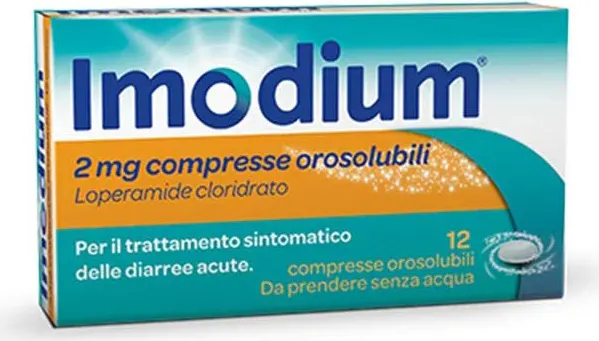
A drug useful for the symptomatic treatment of acute diarrhea.
Imodium orodispersible tablets are used to rapidly relieve diarrhea, even when away from home. Their format, in fact, which dissolves directly in the mouth, allows them to be taken even without water, at any time of the day and with the utmost discretion.
One orodispersible tablet contains:
Active ingredient
Loperamide hydrochloride 2 mg.
Excipients
Gelatin, mannitol, aspartame, mint flavoring, sodium bicarbonate.
Do not use for more than 2 days. In episodes of acute diarrhea, loperamide HCl is generally able to stop the symptoms within 48 hours. If this period elapses without appreciable results, discontinue treatment and consult your doctor. In any case, discontinue treatment when stools return to normal, or if you have not had bowel movements for 12 hours, or if constipation occurs.
Adults
The initial dose is 2 orodispersible tablets (4 mg). Treatment can continue by taking 1 tablet (2 mg) after each subsequent evacuation of soft stools. Do not take more than 8 tablets per day (16 mg).
Children
The initial dose of Imodium for children aged between 6 and 17 years is 1 orodispersible tablet (2 mg). Treatment can continue by taking 1 tablet (2 mg) after each subsequent evacuation of soft stools. The maximum daily dose in children must be established on the basis of body weight (3 capsules or tablets/20 kg), but must not exceed the maximum of 8 capsules or tablets per day (16 mg). There are limited data available regarding the use of loperamide HCl in children under 12 years of age.
Elderly
No dose adjustment is necessary in the elderly.
Subjects with renal impairment
No dose adjustment is necessary in patients with renal impairment.
Subjects with hepatic impairment
Although no data are available in patients with hepatic impairment, loperamide HCl should be used with caution in these patients due to reduced first-pass metabolism.
Allow the tablet to dissolve on the tongue for a few seconds; the tablet will dissolve rapidly in saliva. It does not require the use of water.
Imodium should not be used as primary therapy: in acute dysentery characterized by the presence of blood in the stool and high fever; in patients with acute ulcerative colitis or pseudomembranous colitis due to the use of broad-spectrum antibiotics; in patients with bacterial enterocolitis caused by invasive organisms including Salmonella, Shigella, and Campylobacter.
In general, the use of loperamide HCl is contraindicated in all cases in which inhibition of peristalsis is to be initiated due to the possible risk of significant consequences such as ileus, megacolon, and toxic megacolon.
The treatment of diarrhea with loperamide HCl is only symptomatic. Therefore, where possible, it is also advisable to address the causes of the disorder. In episodes of acute diarrhea, loperamide HCl is generally able to arrest the symptoms within 48 hours; if this period elapses without appreciable results, treatment should be discontinued and the patient should be advised to consult a doctor. In patients with diarrhea, especially in children, a significant loss of fluids and electrolytes may occur. In such cases, it may be necessary to administer a diuretic. Appropriate fluid and electrolyte replacement is very important. Although no pharmacokinetic data are available in patients with hepatic dysfunction, loperamide HCl should be used with caution in these patients due to extensive first-pass metabolism. The drug should be used with caution in patients with hepatic insufficiency as it may lead to relative overdose with CNS toxicity. AIDS patients treated with loperamide HCl for diarrhea should discontinue therapy at the first sign of abdominal distension. Isolated cases of intestinal obstruction with an increased risk of toxic megacolon have been observed in these patients with infectious colitis of bacterial or viral origin treated with loperamide HCl. If constipation, abdominal distension or ileus occur, discontinue treatment immediately.
Paediatric population
In children between 6 and 12 years of age, IMODIUM should be used only under medical supervision. Available data regarding the use of loperamide HCl in children under 12 years of age are limited.
Non-clinical data have shown that loperamide is a substrate of P-glycoprotein.
Concomitant administration of loperamide (a single dose of 16 mg) with quinidine or ritonavir (both inhibitors of P-glycoprotein) has shown a 2- to 3-fold increase in plasma levels of loperamide. The clinical relevance of this pharmacokinetic interaction with P-glycoprotein inhibitors when loperamide is administered at recommended doses (2 to a maximum of 16 mg daily) is unknown.
Concomitant administration of loperamide (a single 4 mg dose) and itraconazole, an inhibitor of CYP3A4 and P-glycoprotein, showed a 3- to 4-fold increase in loperamide plasma levels. In the same study, gemfibrozil, a CYP2C8 inhibitor, showed a 2-fold increase in loperamide plasma levels.
The combination of itraconazole and gemfibrozil showed a 4-fold increase in peak loperamide plasma levels and a 13-fold increase in total plasma exposure. These increases were not associated with central nervous system (CNS) effects as detected by psychomotor tests (e.g., subjective dizziness and the Digit Symbol Substitution Test).
Concomitant administration of loperamide (a single dose of 16 mg) and ketoconazole, an inhibitor of CYP3A4 and P-glycoprotein, resulted in a 5-fold increase in plasma loperamide levels. This increase was not associated with an increase in pharmacodynamic effects as detected by pupillometry.
Concomitant treatment with oral desmopressin resulted in a 3-fold increase in plasma desmopressin concentrations, presumably due to slowed gastrointestinal motility.
Concomitant use of CYP450 inhibitors is not recommended.
Substances that accelerate gastrointestinal transit may decrease the effect of IMODIUM. Drugs with pharmacological properties similar to those of loperamide or drugs that can slow intestinal peristalsis (e.g. anticholinergics) may increase the effect of IMODIUM.
Adults and children aged ≥12 years
Adverse reactions reported in clinical studies with loperamide HCl
The safety of Loperamide HCl has been evaluated in 3076 adult subjects and children aged ≥12 years who participated in 31 controlled and uncontrolled clinical studies with loperamide HCl used for the treatment of diarrhea. Of these, 26 studies were for acute diarrhoea (N=2755) and 5 for chronic diarrhoea (N=321).
The most commonly reported adverse drug reactions (ADRs) (i.e. with an incidence >1%) in clinical trials with Loperamide HCl for the treatment of acute diarrhoea were: constipation (2.7%), flatulence (1.7%), headache (1.2%) and nausea (1.1%).
In clinical trials for the treatment of chronic diarrhoea, the most commonly reported ADRs were: constipation (2.7%), flatulence (1.7%), headache (1.2%) and nausea (1.1%).
Commonly reported (i.e. ≥1% incidence) were: flatulence (2.8%), constipation (2.2%), nausea (1.2%) and dizziness (1.2%).
Adverse reactions reported in post-marketing experience with loperamide HCl
Determination of adverse reactions from post-marketing experience for loperamide HCl does not distinguish between acute and chronic diarrhoea indications or between adult and paediatric populations; The data collected therefore represent the combination of indications (acute and chronic diarrhea) and populations (adults and children).
Adverse reactions observed during post-marketing experience for loperamide HCl are listed below.
Immune system disorders: hypersensitivity reaction, anaphylactic reaction (including anaphylactic shock), anaphylactoid reaction.
Nervous system disorders: drowsiness, loss of consciousness, drowsiness, depressed level of consciousness, hypertonia, coordination disorders.
Eye disorders: miosis. Gastrointestinal disorders: ileus (including paralytic ileus), megacolon (including toxic megacolon), glossodynia.
Skin and subcutaneous tissue disorders: Bullous eruption (including Stevens-Johnson syndrome, toxic epidermal necrolysis, and erythema multiforme), angioedema, urticaria, pruritus.
Renal and urinary disorders: Urinary retention.
General disorders and administration site conditions: Fatigue.
Paediatric population
The safety of loperamide HCl has been evaluated in 607 patients aged 10 days to 13 years, who participated in 13 controlled and uncontrolled clinical trials with loperamide HCl used for the treatment of acute diarrhoea. In general, the ADR profile in this patient population was similar to that observed in clinical studies with loperamide HCl used in adults and children aged 12 years and above.
Administration of IMODIUM is contraindicated during pregnancy and breastfeeding. Pregnant or breastfeeding women should therefore be advised to consult their doctor for the most appropriate treatment.
Store in the original package in order to protect from moisture. Store the medicine at a temperature not exceeding 25°C.
Pack with 12 orodispersible tablets of 2 mg
This product has been on sale since 25/09/2017
In the last 30 days, the product's lowest price was 11,45 €
Al bisogno serve proprio, ti ferma il problema delle scariche ,buon prodotto.
ottimo alleato sopratutto in caso di diarrea del viaggiatore o in caso di diarrea momentanea.
Prodotto Ottimo
Indispensabile
Funziona benissimo


