




Recommended price

€7.05
Get free shipping with a minimum spend of 69,00 €. Or by purchasing one of the selected products. Discover them now!
 Richiedi info sul prodotto

Information on returns and shipments

Payment methods

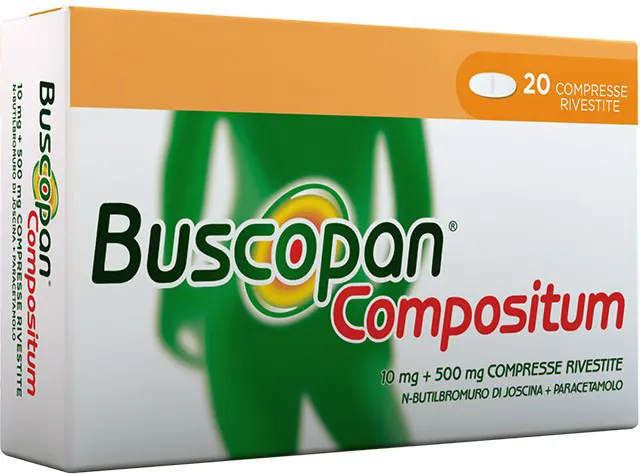
Tablets for the treatment of severe spastic pain in the gastrointestinal or genitourinary tract.
Buscopan Compositum is indicated in the treatment of paroxysmal pain in gastrointestinal tract disorders, spastic pain, dyskinesia of the urinary and biliary tract, dysmenorrhea.
Active Ingredients
One coated tablet contains: Active ingredients: N-butyl hyoscine bromide 10 mg, paracetamol 500 mg.
Excipients
Core: microcrystalline cellulose, sodium carmellose, corn starch, ethylcellulose, colloidal silica, magnesium stearate.
Coating: hypromellose, polyacrylates, titanium dioxide, macrogol 6000, talc, silicone - antifoaming agent.
The following dosage is recommended for adults, unless otherwise prescribed by your doctor: 1-2 tablets, 3 times a day.
Do not exceed 6 tablets per day.
The tablets should not be chewed, but swallowed whole with a sufficient amount of water.
Buscopan compositum should not be used in case of:
The use of Buscopan compositum is contraindicated in case of rare hereditary conditions that may be incompatible with an excipient of the product.
Buscopan compositum should not be taken for more than 1 month. Continue for 3 days unless directed by your doctor. Instruct the patient to contact their doctor if the pain persists or worsens, if new symptoms occur, or if redness or swelling occurs, as these could be symptoms of a serious condition. If severe abdominal pain of unknown origin persists, worsens, or is accompanied by symptoms such as fever, nausea, vomiting, changes in bowel movements, a distended abdomen, low blood pressure, fainting, or blood in the stool, seek medical attention immediately. To prevent overdose, ensure that other medications taken at the same time do not contain paracetamol, one of the active ingredients in Buscopan compositum. Liver damage may occur if the recommended dose of paracetamol is exceeded. Buscopan compositum should be used with caution in case of:
Administer with caution in subjects with renal or hepatic insufficiency. In these conditions, Buscopan compositum should be administered only under medical supervision, if necessary, reducing the dose or prolonging the interval between individual administrations. Blood counts and renal and hepatic function should be monitored after prolonged use. The extensive use of analgesics, especially at high doses, can induce headache which should not be treated with increased doses of the medicine. Severe acute hypersensitivity reactions (e.g., anaphylactic shock) are observed very rarely. Treatment should be discontinued at the first signs of a hypersensitivity reaction following administration of Buscopan compositum. Abrupt discontinuation of analgesics after prolonged use at high doses may cause withdrawal symptoms (e.g., headache, fatigue, nervousness), which usually resolve within a few days. Resumption of analgesics should be subject to medical advice and resolution of withdrawal symptoms. Due to the potential risk of anticholinergic complications, it should be used with caution in patients predisposed to narrow-angle glaucoma, in patients subject to intestinal or urinary tract obstruction, and in those prone to tachyarrhythmia with central autonomic nervous system disorders, in tachyarrhythmias, in arterial hypertension, in congestive heart failure, and in hyperthyroidism. All antimuscarinics reduce the volume of bronchial secretions; Therefore, they should be used with caution in patients with chronic obstructive inflammatory diseases of the respiratory system. During treatment with paracetamol, before taking any other medication, check that it does not contain the same active ingredient, since serious adverse reactions may occur if paracetamol is taken in high doses. Instruct the patient to contact their doctor before combining any other medication. Buscopan compositum 10 mg + 500 mg tablets contain 4.32 mg of sodium per tablet. To be taken into consideration by patients on a controlled sodium diet.
Pregnancy
There are no adequate data on the use of Buscopan compositum during pregnancy. Long-standing experience with the two substances as monotherapy has indicated insufficient evidence of adverse effects during pregnancy in women. After the use of hyoscine N-butylbromide, preclinical studies in rats and rabbits have shown neither embryotoxic nor teratogenic effects. Potential data on paracetamol overdose during pregnancy have not shown an increased risk of malformations. Reproduction studies investigating oral use have shown no signs suggesting malformations of fetotoxicity. Under normal conditions of use, paracetamol can be taken during pregnancy after careful consideration of the risk-benefit ratio. During pregnancy, paracetamol should not be taken for prolonged periods, at high doses, or in combination with other medications, as safety has not been confirmed in such cases. Therefore, Buscopan compositum is not recommended during pregnancy.
Breastfeeding
The safety of hyoscine N-butylbromide during breastfeeding has not yet been established. Paracetamol is excreted in breast milk. However, at therapeutic doses, it is expected that no adverse effects in the newborn will occur. The decision to continue or discontinue breastfeeding or to continue or discontinue therapy with Buscopan compositum must be made taking into account the benefits of breastfeeding for the child and the benefits of therapy with Buscopan compositum for the mother.
Fertility
No studies on the effects on fertility in humans have been conducted.
Use with extreme caution and under close monitoring during chronic treatment with drugs that can cause the induction of hepatic monooxygenases or in case of exposure to substances that can have this effect (for example rifampicin, cimetidine, antiepileptics such as glutethimide, phenobarbital, carbamazepine). The same situation occurs with potentially hepatotoxic substances and with alcohol abuse. Concomitant administration of chloramphenicol can cause hepatotoxicity. induce a prolongation of the half-life of chloramphenicol, with the risk of increasing its toxicity. Since the clinical relevance of paracetamol interactions with warfarin and coumarin derivatives has not yet been established, long-term use of Buscopan compositum in patients undergoing therapy with oral anticoagulants should only occur under medical supervision. Concomitant use of paracetamol and zidovudine (AZT or retrovir) increases the tendency to reduce leukocyte counts (neutropenia). Therefore, Buscopan compositum should be taken together with zidovudine only under medical supervision. Probenecid inhibits the binding of paracetamol to glucuronic acid, thereby reducing paracetamol clearance by approximately a factor of 2. The dose of paracetamol should therefore be reduced during concomitant administration with probenecid. Cholestyramine reduces the absorption of paracetamol. Paracetamol administration may interfere with the determination of uric acid levels (using the phosphotungstic acid method) and blood glucose levels (using the glucose-oxidase-peroxidase method). The anticholinergic effect of drugs such as tricyclic and tetracyclic antidepressants, antihistamines, antipsychotics, quinidine, amantadine, disopyramide, and other anticholinergics (e.g., tiotropium, ipratropium, atropine-like substances) may be potentiated by Buscopan compositum. Concomitant treatment with dopamine antagonists, such as metoclopramide, may reduce the effect of both drugs on the gastrointestinal tract. Tachycardia induced by beta-adrenergic drugs may be potentiated by Buscopan compositum. The tachycardic effects of beta-adrenergic agents may be intensified by Buscopan compositum. In addition, for oral use: drugs that slow gastric emptying (e.g. propantheline) can reduce the rate of absorption of paracetamol, delaying its therapeutic effect; on the contrary, drugs that increase the rate of gastric emptying (e.g. metoclopramide) lead to an increase in the rate of absorption of paracetamol.
Adverse reactions are listed below by system organ class and frequency, according to the following categories:
very common: > 1/10; common: > 1/100 – <1/10; uncommon: > 1/1,000 – <1/100; rare: > 1/10,000 – <1/1,000 Very rare: <1/10,000; not known: frequency cannot be estimated from the available data.
Blood and lymphatic system disorders: Not known: pancytopenia, agranulocytosis, thrombocytopenia, leukopenia. Immune system disorders, skin and subcutaneous tissue disorders: Uncommon: skin reactions, abnormal sweating, pruritus, nausea. Rare: erythema, decreased blood pressure including shock. Not known: anaphylactic shock, anaphylactic reactions, drug-induced skin reaction, dyspnoea, hypersensitivity, angioedema, urticaria, rash, exanthema. Very rare cases of serious skin reactions (such as Stevens-Johnson syndrome (SJS), toxic epidermal necrolysis (TEN), and generalized exanthematous pustulosis (AGEP)) have been reported with the use of paracetamol. Cardiac disorders: Rare: tachycardia. Respiratory, thoracic and mediastinal disorders: Not known: bronchial muscle spasms (especially in patients with a history of bronchial asthma or allergy). Gastrointestinal disorders: Uncommon: dry mouth. Hepatobiliary disorders: Not known: increased transaminases. Renal and Urinary: Not known: urinary retention. Cases of erythema multiforme have been reported with the use of paracetamol. Hypersensitivity reactions such as angioedema and laryngeal edema have been reported. The following adverse reactions have also been reported: anemia, liver function disorders and hepatitis, renal disorders (acute renal failure, interstitial nephritis, hematuria, anuria), gastrointestinal reactions, and dizziness. Drowsiness, mydriasis, accommodation disorders, increased ocular pressure, constipation and difficulty urinating have also been reported.
Due to paracetamol overdose, elderly people, young children, patients with liver disorders, chronic alcohol consumption or chronic malnutrition, as well as patients treated with enzyme-inducing drugs are at increased risk of intoxication, even with fatal outcome.
Symptoms
N-hyoscine butylbromide In case of overdose, anticholinergic effects have been observed.
Paracetamol In cases of chronic intoxication, haemolytic anaemia, cyanosis, weakness, dizziness, paraesthesia, tremors, insomnia, Headache, memory loss, central nervous system irritation, delirium, and convulsions. Symptoms typically appear during the first 24 hours and include pallor, nausea, vomiting, anorexia, and abdominal pain. Patients may then experience temporary subjective improvement, but mild abdominal pain, possibly indicative of liver damage, may persist. Significant elevations in transaminases, jaundice, coagulation disorders, hypoglycemia, and hepatic coma may occur. A single dose of paracetamol of approximately 6 g or more in adults or 140 mg/kg in children can cause hepatocellular necrosis. This can lead to irreversible complete necrosis and subsequently hepatocellular failure, metabolic acidosis, and encephalopathy, which may progress to coma and death. Concurrent increases in liver transaminases (AST, ALT), lactate dehydrogenase, and bilirubin, and an increase in prothrombin time, occurring 12–48 hours after ingestion, have been observed. Clinical symptoms of liver damage are usually evident after 2 days and reach a maximum after 4–6 days. Acute renal failure with acute tubular necrosis may develop even in the absence of severe liver damage. Other non-hepatic symptoms, such as myocardial abnormalities and pancreatitis, have also been reported to occur after paracetamol overdose.
Therapy
N-hyoscine butylbromide If required, parasympathomimetic drugs should be administered. In cases of glaucoma, an ophthalmological examination should be performed urgently. Cardiovascular complications should be treated according to standard therapeutic principles. In case of respiratory paralysis, intubation and artificial respiration should be considered. For urinary retention, catheterization may be necessary. Additionally, appropriate supportive measures should be used as needed.
Paracetamol Where paracetamol intoxication is suspected, intravenous administration of group SH donors such as N-acetylcysteine is indicated within the first 10 hours of ingestion. Although N-acetylcysteine is most effective when administered within this period, it may still offer some protection if administered 48 hours after ingestion; in this case, it should be taken for a longer period. Plasma paracetamol concentrations can be lowered by dialysis. Quantitative analysis of plasma paracetamol concentrations is recommended. Further measures will depend on the severity, nature, and course of clinical symptoms of paracetamol intoxication and should follow standard intensive care protocols.
20 coated tablets
This product has been on sale since 25/09/2017
In the last 30 days, the product's lowest price was 11,22 €
Finalmente è tornato. Ottimo prodotto
Prodotto che uso da anni contro il mal di stomaco e di pancia. Nel giro di 10 minuti mi passa il dolore.
È un farmaco molto valido
Ottimo prodotto
Prodotto che già conoscevo,ad un prezzo super


